











If you arrived here through the ABF Agent, you have already experienced the result.
Perhaps you asked what a sp...
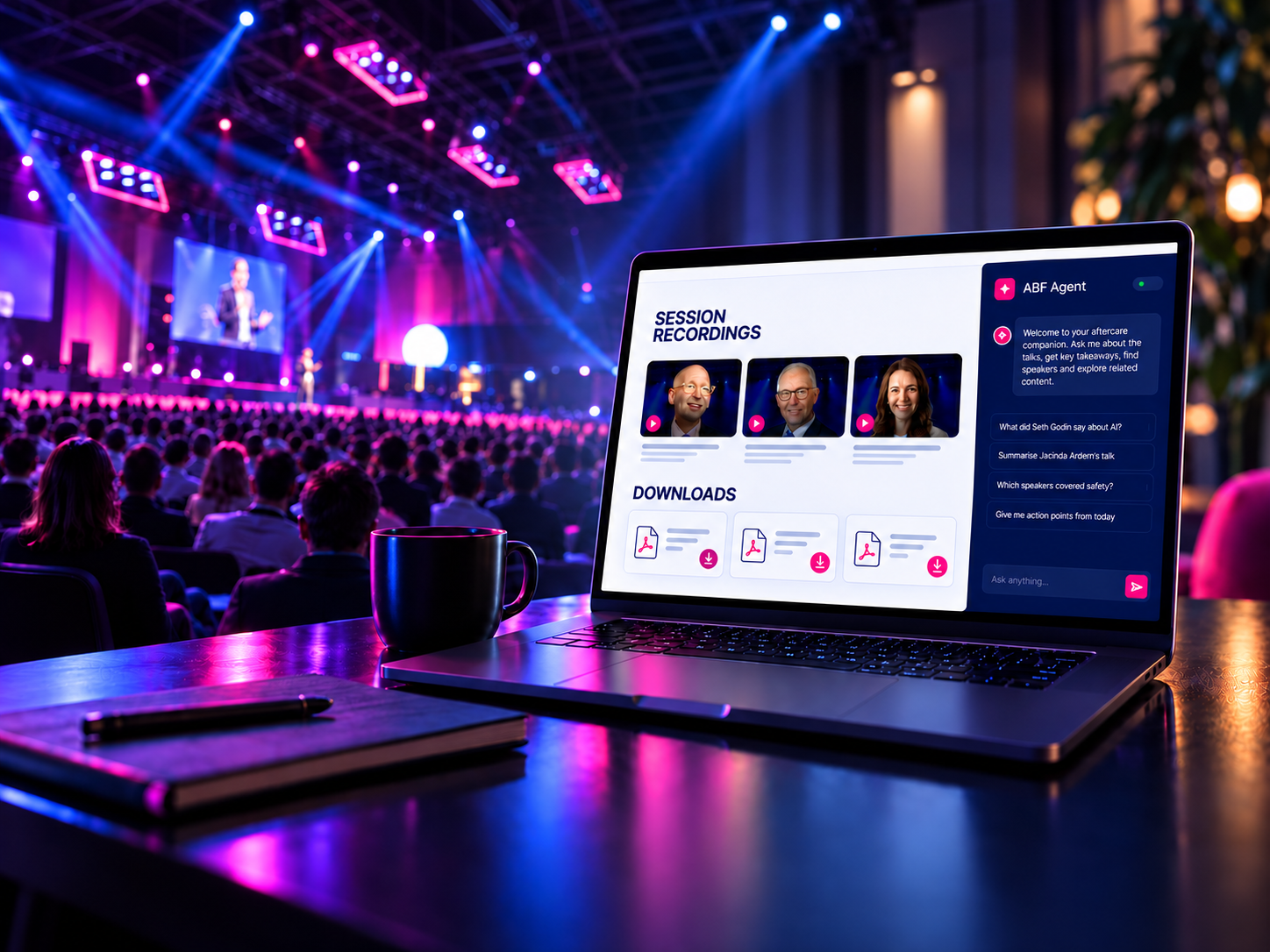
If you arrived here through the ABF Agent, you have already experienced the result.
Perhaps you asked what a speaker said about a particular topic, compared ideas across sessions or explored how an insight could be applied in your organisation. What looks like a simple chat window is actually the final layer of a much broader solution.
For Amsterdam Business Forum, Silverside and DenkProducties transformed 258 sources across six speakers into a structured knowledge experience, integrated directly into the participant aftercare platform.
The goal was not to build another chatbot. It was to make the knowledge behind the event easier to find, connect and apply.
A major event produces a considerable amount of valuable content. Before the event, there are books, articles, interviews, podcasts, videos and speaker websites. During and afterwards, recordings, summaries and final takeaways are added. The problem is not a lack of information. It is finding the right information at the right moment.
Instead of searching through hundreds of sources, participants can simply ask the ABF Agent. They can revisit ideas, compare perspectives across speakers, connect information from multiple sources and trace answers back to relevant source material.
But giving an AI model access to 258 sources does not automatically create a reliable knowledge solution.
We organised the content by speaker, topic, key ideas and relevance, and defined how information should be prioritised and referenced. Important sources form the primary basis for answers, while supporting content provides additional context. That gives us something far more useful than a large collection of documents: a managed knowledge layer behind the AI.
This became one of the most interesting design challenges. Before the event, available knowledge describes a speaker's published ideas and expected themes. Afterwards, we also know what was actually said at Amsterdam Business Forum.
We therefore created a PRE and POST knowledge model.
PRE contains approved information available before the event. POST contains validated information produced during or after it. When newer information explicitly supersedes older information, POST takes priority without making all existing knowledge obsolete.
We tested this before the final event materials even existed by deliberately creating conflicting test information. The agent had to recognise the newer information while retaining earlier content that was still valid.
This principle extends far beyond events. Organisations constantly deal with revised policies, changing products, new procedures and decisions that replace earlier guidance. A serious knowledge agent should not only find information. It should also know which information to trust.
The ABF Agent is built using Microsoft Copilot Studio, but participants never need to work in Copilot Studio itself. They experience the agent directly inside the DenkProducties aftercare platform, alongside recordings and other event materials.
Silverside developed a custom interface using Microsoft Bot Framework Web Chat, with ABF and Microsoft branding, suggested questions, tailored answers and sources, responsive design and status and error handling.
Behind that experience, we deliberately separated the knowledge and agent layer from the user experience layer. Content can be updated without redesigning the interface, while the experience can evolve without rebuilding the agent.
For IT, that separation creates a more manageable architecture.
For the participant, only one thing really matters: does it work?
A working AI demo is relatively easy. Making it suitable for real users is a different challenge. With thousands of potential users, security, monitoring, availability and cost control become part of the architecture. The production ABF Agent therefore uses a protected server-side service to issue temporary chat tokens. Permanent connection credentials are not exposed in the participant's browser.
The production design also includes request validation, rate limiting, usage quotas, monitoring, budget alerts and the ability to stop new sessions if required. This is an important distinction between experimenting with AI and operating it.
A production agent needs more than good prompts and a capable model. It needs knowledge management, governance, security and operational control.
1. An agent is only as useful as the knowledge behind it.
Hundreds of documents do not automatically become a reliable knowledge base. Information needs structure, priorities, ownership and rules for change.
2. Users experience the complete solution, not the AI model.
The interface, integrations, speed, sources and error handling matter just as much as the quality of the generated answer.
3. Production changes the conversation.
The question moves from “Can we make this work?” to “Can we trust, manage, secure and maintain it?”
These lessons apply to much more than an event.
Imagine customers exploring your expertise without navigating dozens of web pages. Employees asking questions across policies, procedures and internal knowledge instead of searching multiple systems. Or sales and service teams having immediate access to current product and proposition knowledge.
The technology makes many of these scenarios possible. But at Silverside, we do not start with:
“Which AI agent should we build?”
We start with:
“What should your customers or employees be able to do that is difficult today?”
From there, we look at the complete picture: the use case, users, knowledge, integrations, governance, security, adoption and costs. Sometimes that leads directly to an agent. Sometimes the first step is improving the knowledge foundation or governance. Because a successful agent does not begin with a chat window.
It begins with a problem worth solving - and ends with a solution people actually use.
If you are considering an AI agent for customers, employees or another knowledge-intensive process, talk to Silverside.
We can help you determine the right use case, what knowledge and architecture it requires, and what it takes to move from an AI idea to a secure, manageable production solution.